|
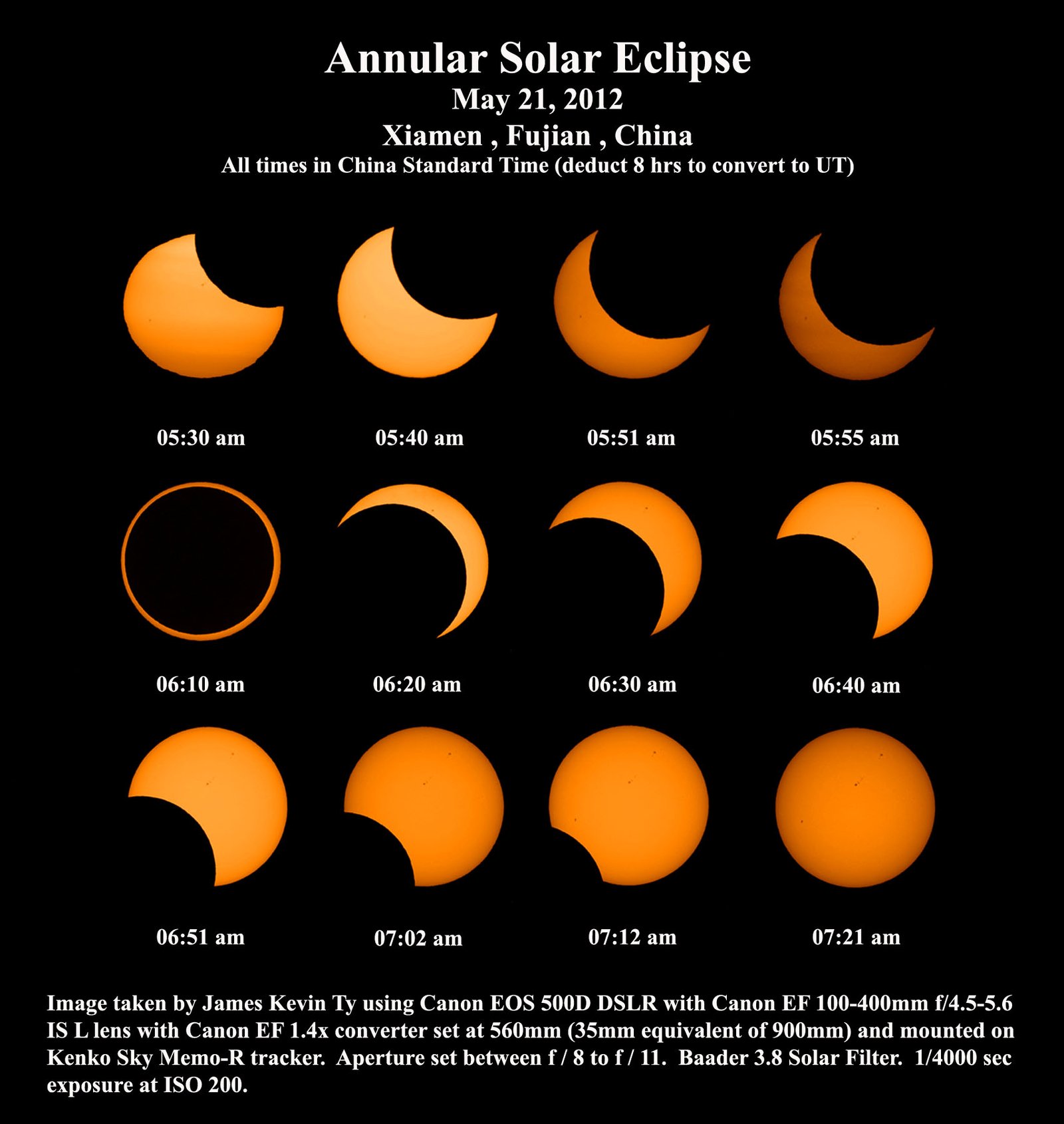
DECEMBER 26, 2019 ANNULAR SOLAR ECLIPSE by James Kevin Ty This coming December 26, there will be an annular solar eclipse that will be visible from the Arabian peninsula like Oman and then proceed to pass part of India and then progressed to South East Asia where it will pass parts of Indonesia, Singapore, Borneo and Philippines before it exits in the Pacific Ocean. Since we will be observing this eclipse here in South East Asia, my concentration will focus on Singapore and Philippines. South East Asia such as Singapore as well as the southernmost part of the Philippines in Balut Island and Sarangani province will witness an annular solar eclipse while the rest of the Philippines will see a partial solar eclipse. Few solar eclipse tracks manage to cover a larger range of climate types than this post-Christmas annular in 2019. Along its journey from the deserts of the Arabian Peninsula, across Peninsular India, through tropical Indonesia, and on to the moderating influences of the mid-Pacific Ocean, the track samples climates where cloudiness for the month ranges from as low as 7 percent to as much as 97 percent. Such variety ensures that the avid eclipse traveler will find sites with excellent weather prospects, especially in Arabia and parts of India. WARNING !!! OBSERVING THE SUN AS WELL AS DURING THE SOLAR ECLIPSE IS DANGEROUS AND CAN CAUSE SEVERE EYE INJURY OR BLINDNESS WITH THE USE OF PROPER SAFETY SOLAR GLASSES OR SOLAR FILTER SO EXTREME PRECAUTION IS NEEDED AND BEST SUPERVISED BY AN EXPERIENCE SOLAR OBSERVER AND IMAGER.
Indonesia, Singapore, and the Philippines The increasing southeasterly track of the Moon’s shadow takes it deep into equatorial moisture and the extensive cloudiness that marks the personality of the ITCZ. The center line trace of monthly cloudiness increases as it moves from Sri Lanka over to the South Eastb Asia region where a value of more than 85 clodiness% by the peninsula of North Sumatra. At Singapore, where totality occurs at noon, satellite measurements of cloud cover reach 95%, a value that seems far too high in view of the approximately 33 percent of possible sunshine at most stations. However, the surface-based cloud observations are in close agreement, with no observations at all of clear skies and a 93-100% frequency of broken and overcast skies at most of the stations. This is a very cloudy region of the globe, especially in the afternoon. and there is evidence that the proximity to water brings some relief from the cloudiness, something that can be expected from theoretical grounds and can be matched with land-ocean boundaries. One of this is the west of Singapore, one west of Singkawang City, and another near Pulau Miangas. For the most part, it’s only a 10% drop in cloud cover, but in such a cloudy environment, suggests a direction and place to go to watch the eclipse.
As the track draws away from its most southerly point and heads toward the northeast, it gradually leaves the equatorial climate and the ITCZ. Cloudiness drops slowly and steadily from Kalimantan (Borneo) onward so that by the time the shadow says goodbye to the southern tip of the Philippines, the average cloudiness has dropped below 80 percent. But since the annularity path only pass through the southern most part of Mindanao, in the Sarangani province area, specially the Balut Islands, the question of security posed a questionable problem specially for foreigners whereas there are cases of rebels kidnappings are pretty high in that southernly region so extreme precaution is the best advise to travel to these areas unless the local government there will address these issues with assured tight security to protect eclipse viewers who will travel there. For this event, members of the Astronomical League of the Philippines will send an eclipse expedition team to Singapore to document this eclipse as well as partial eclipse observations around the country. Below are eclipse circumstances to guide you on what to expect on this eclipse. To view an eclipse simulation on the selected cities below, kindly click on the highlighted city link below. ANNULAR SOLAR ECLIPSE CIRCUMSTANCES
JURONG LAKE , SINGAPORE ( 1 deg 20' 22" N , 103 deg 43' 34" E )
BALUT ISLAND , SARANGANI , PHILIPPINES ( 5 deg 23' 52" N , 125 deg 22' 46" E )
PARTIAL SOLAR ECLIPSE CIRCUMSTANCES
MANILA , PHILIPPINES ( 14 deg 36' 00" N , 120 deg 59' 30" E )
BAGUIO CITY , PHILIPPINES ( 16 deg 24' 08" N , 120 deg 35' 46" E )
CEBU CITY , PHILIPPINES ( 10 deg 17' 00" N , 123 deg 54' 00" E )
DAVAO CITY , PHILIPINES ( 7 deg 30' 00" N , 126 deg 00' 00" E )
WARNING !!! OBSERVING THE SUN AS WELL AS DURING THE SOLAR ECLIPSE IS DANGEROUS AND CAN CAUSE SEVERE EYE INJURY OR BLINDNESS WITH THE USE OF PROPER SAFETY SOLAR GLASSES OR SOLAR FILTER SO EXTREME PRECAUTION IS NEEDED AND BEST SUPERVISED BY AN EXPERIENCE SOLAR OBSERVER AND IMAGER. To safely observe the eclipse, one needs to use a solar filter made of glass as well as high quality mylar film suh as Baader Astro Solar Filter is highly recommended. Use of welders glass #14 as well as safe solar eclipse glasses can also be safely use to view this event safely. I would also recommend joining astronomy clubs such as the Astronomical League of the Philippines who will setup various free public solar viewing sites such as in SM By The Bay Amusement Park, etc. They will setup telescopes that have safe solar filters installed in their telescopes for you to observe the the Sun and eclipse safely. For more details, you may contact James Kevin Ty for more details on the eclipse as well as free solar public viewing sites that will be setup by members of the Astronomical League of the Philippines. Maps and illustrations courtesy of Fred Espenak, Eclipse 2.0 and Google Maps
SIGN MY GUESTBBOOK
HOME ABOUT ME MY BLOG PAGE ARTICLES LINKS EMAIL A Proud Member Of The
|
|
You are our
since May 15, 2008 |
All the pages, text and images found in this site are (c) Copyright 2003, 2004 , 2005 , 2006 , 2007 , 2008 , 2009, 2010 by James Kevin Ty. Any use of these materials in any form without the prior written consent or knowledge of the author is a violation of Philippine and worldwide copyright laws and may cause the author to send lawyers after you. Since the author is a very reasonable and approachable person, ask his permission and might probably work out a reasonable arrangement.